

Voluntary Principles at 25: Advancing Security and Human Rights in a Changing World
December 19, 2025 •
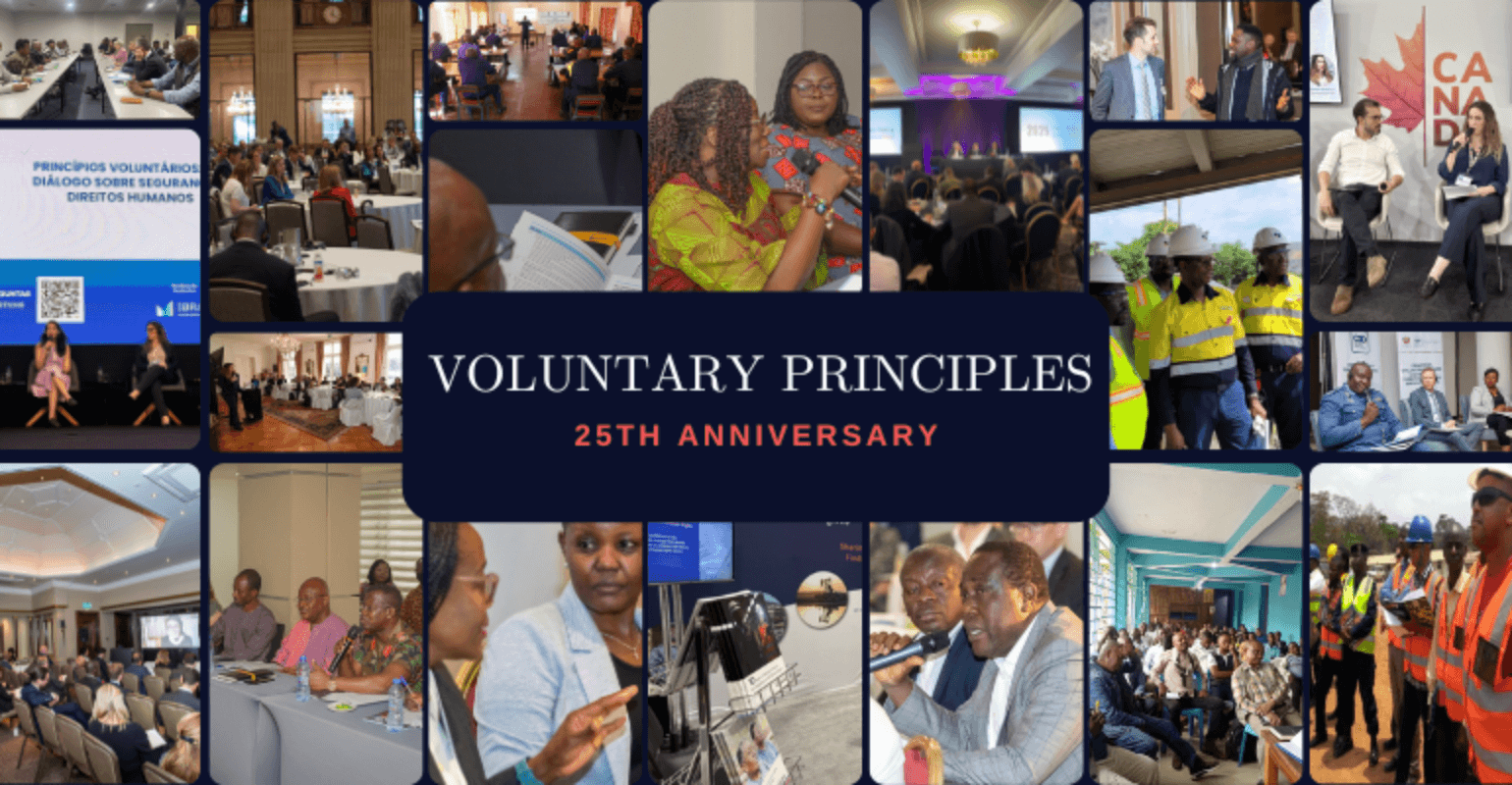
Twenty-five years ago, the Voluntary Principles on Security and Human Rights (VPSHR) were created to address an urgent challenge: how companies operating in high-risk environments can protect their people and assets without contributing to human rights abuses. Throughout the 1990s, a series of grave human rights incidents involving corporate security arrangements highlighted the absence of clear guidance for companies operating in complex environments. The VPSHR emerged in direct response, reflecting a growing recognition among governments, companies, and civil society that legitimate security needs must never come at the expense of human rights.
The VPSHR is now implemented in more than 150 countries. Its use has expanded beyond mining and oil and gas as companies in renewable energy, agriculture, logistics, manufacturing, and infrastructure construction face similar challenges – contracting private security, engaging with public forces, operating in areas affected by violence or weak governance, and navigating social conflict around land, water, and environmental impacts. Across all high-risk activities, the VPSHR offers a practical and field-tested approach for managing the complex intersection of security, conflict, and human rights.
Today’s world is defined by growing uptake of the UN Guiding Principles, higher stakeholder expectations and improved company conduct, but also faced with geopolitical fragmentation, competition for critical minerals, shrinking civic space. Against such a backdrop, the VPSHR remains the leading global framework for managing security arrangements in ways that respect human rights, particularly in complex and high-risk environments. The Principles are now embedded in over a dozen of responsible business standards, supply chain mechanisms, and soft law instruments such as OECD Due Diligence Guidance for Responsible Supply Chains of Minerals from Conflict-Affected and High-Risk Areas, and the Responsible Jewellery Council Code of Practice.
The current Chair of the Voluntary Principles, the Government of the United Kingdom, reflects on the continued relevance of the framework: “As a founding government, the United Kingdom celebrates twenty five years of the Voluntary Principles on Security and Human Rights, a framework that continues to shape ethical security worldwide.”
The Voluntary Principles Initiative: A Multi-Stakeholder Platform that Endured
While the VPSHR marks its 25th anniversary this year, the multi-stakeholder platform created to promote and support its implementation, has also grown significantly since its establishment. The Voluntary Principles Initiative (VPI) stemmed from the collaborative dialogue that characterized the creation of the Principles. Governments, companies, and NGOs saw value in maintaining that dialogue to address practical challenges in implementing the VPSHR. At the time, this kind of cooperation was not the norm. The founding governments, principally the United States and the United Kingdom, played a key role in convening stakeholders who had previously engaged mainly across protest lines or through investigative reporting.
The result was a unique, multi-stakeholder platform grounded in shared commitment to human rights and the recognition that preventing security-related human rights abuses is a responsibility held by each actor individually, yet enhanced through constructive collaboration. Governments contribute policy leadership and diplomatic weight; companies bring operational responsibility and the ability to implement, and NGOs provide expertise, insights and scrutiny. This tripartite model has proven remarkably resilient over the past quarter century. Today, as the only global platform uniting governments, companies, and civil society to address security and human rights, the VPI has grown into a network of more than 80 Member and Observer organizations, underscoring the continued need for shared solutions in an increasingly complex world.
According to the VPI’s Corporate Pillar Chair, Anaïs de Meulder of Shell: “The Voluntary Principles Initiative has been instrumental in guiding Shell’s approach to security and human rights. As a founding member of the Voluntary Principles Initiative on Security and Human Rights, Shell has observed how implementing the VPs has helped us in our efforts to keep staff and facilities safe while respecting the human rights and security of local communities. Being part of this initiative has facilitated collaboration across peers, governments, and civil society, and allowed us to incorporate best practices aimed at promoting respect for human rights.”
Supporting Implementation On-the-Ground: The Role of ICWGs
Ultimately, the effectiveness of any framework comes down to how well it is implemented in local contexts. Over the past several years, the VPI’s In-Country Working Groups (ICWGs) have assisted this work.
Active VPI ICWGs in Chile, Brazil, Ghana, and Nigeria, as well as partner working groups in Colombia, Peru, Mozambique, and the Democratic Republic of Congo, bring together representatives from government, companies, and civil society to identify local security-related human rights challenges, share information, and develop collective solutions. The ICWGs address implementation challenges that are context-specific; promote dialogue among stakeholders; and play an important role in supporting the application of the VPSHR at the project, national, and regional levels.
Global Guidance Tools That Drive Implementation
One major achievement linked to the VPI’s multi-stakeholder collaboration has been the development of practical tools and guidances designed to help stakeholders put the Principles into action. Through sustained multi-stakeholder dialogue and negotiation, the Initiative has produced a suite of leading resources that reflect international best practice in managing security and human rights risks in complex environments.
This work began with the foundational Implementation Guidance Tools (IGT), which remain a cornerstone guidance for companies seeking a strong methodology to conduct security and human rights risk assessments and how to effectively mitigate those risks. Over time, the VPI expanded its set of tools to equip practitioners with the right skills in address emerging risks, evolving expectations, and the needs of specific groups and contexts. Newer resources include 10 Steps to Maintain Security in Compliance with Human Rights, which offers concise and operational steps on VPSHR implementation; the Conflict Analysis Tool for Companies, which supports contextual assessment of conflict dynamics; and the IGT Companion Tool, which the operationalizes the VPSHR through the lens of protecting and respecting the rights of women and other disadvantaged groups.
Recognizing the increasing risks faced by human rights defenders, the VPI also developed its Guidance on Respecting the Rights of Human Rights Defenders, reinforcing the Initiative’s commitment to ensuring that companies take reasonable steps to ensure their employees and contractors are respecting the rights of those who raise concerns on the ground. By continuing to evolve its tools in this way, the VPI helps ensure that the VPSHR remains a practical, living framework for responsible security in a rapidly changing world.
Highlighting the vital role of civil society in the VPI, James McQuilken of Pact noted: “As NGO Pillar Chair, Pact is pleased to celebrate 25 years of the Voluntary Principles. The VPs have helped security providers protect and respect the human rights of local communities at thousands of mining and oil and gas project sites over the past 25 years. We are especially proud of the role NGOs have played in helping to develop and implement security and human rights best practices, particularly in challenging contexts, both on the ground and at the global level in the form of tools and guidance. Current global trends make the VPs more important than ever, and we look forward to supporting their continued implementation for years to come.”
Sustaining the Momentum
Mandatory human rights due diligence (mHRDD) regulations have emerged across Europe and are shaping global expectations. In this evolving regulatory landscape, the Voluntary Principles offer a leading global framework on security and human rights that companies can use to interpret, align with, and implement instruments such as the EU’s Corporate Sustainability Due Diligence Directive (CSDDD) and other mHRDD laws. Where legislation sets out the “what” of due diligence, the VPSHR helps companies answer the “how” of security-related human rights compliance, especially in complex and high-risk environments.
Building on this role, the VPI is developing a new guidance on human rights due diligence as it relates to security operations. This resource will provide an overview and analysis of requirements across the full cycle of human rights due diligence – from stakeholder engagement and risk assessment to prevention, mitigation, and remediation – and clarify how companies can align their security practices with the VPSHR, with the UN Guiding Principles and with mandatory due diligence laws such as the EU Corporate Sustainability Due Diligence Directive. It aims to set out good practices for effective due diligence on all human rights impacts linked to security operations, for companies in any sector.
Celebrating 25th Anniversary Milestone
As the Voluntary Principles mark this important milestone, we welcome reflections from practitioners, partners, and stakeholders on how the VPSHR has shaped their work and supported implementation on the ground. If you would like to share your thoughts with the VPI, please send them to the Secretariat at kiki.zheng@voluntaryprinciples.org.